Centre revokes NSA detention of Ladakhi activist Sonam Wangchuk, orders immediate release
The government noted that Wangchuk had already completed nearly half of the permissible detention period under the Act.
According to Wangchuk, the proposed legislative structure would hold financial, executive and law-making authority, marking a major shift in Ladakh’s administrative framework since it became a Union Territory in 2019.




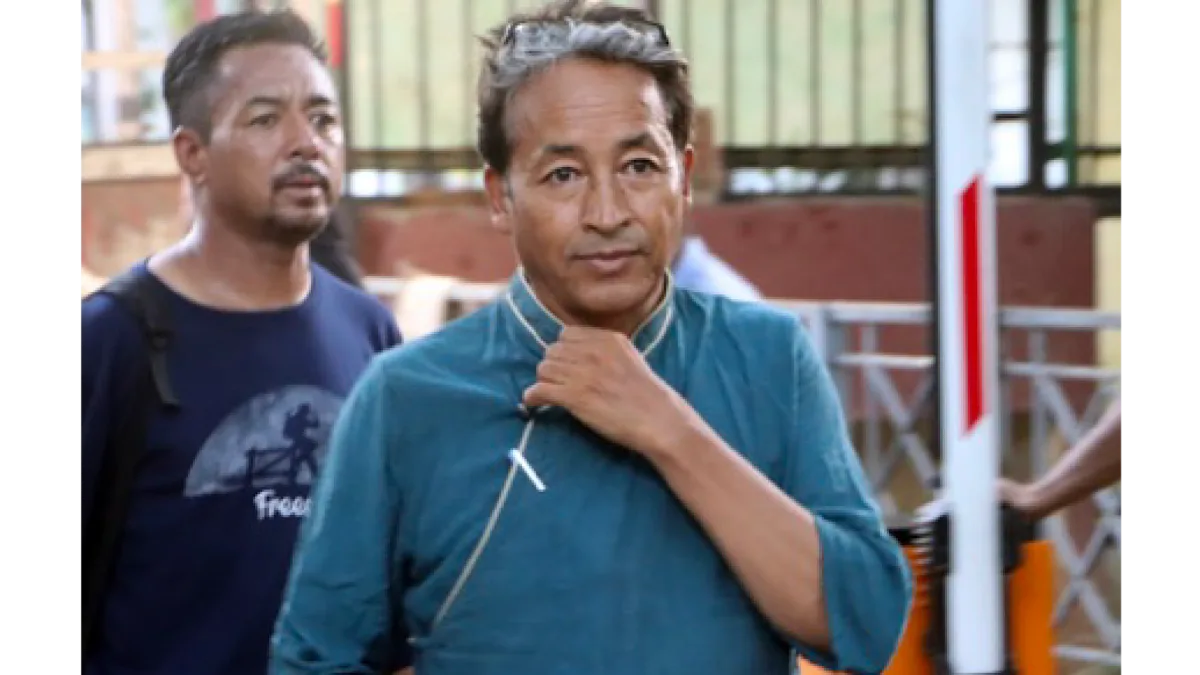
‘In-principle understanding reached with Centre’: Sonam Wangchuk on restoring democracy in Ladakh after talks with MHA (File Photo: IANS)
Climate activist and Ladakh campaigner Sonam Wangchuk on Saturday called the latest round of talks between the Centre and Ladakhi representatives a significant step towards restoring democratic governance in the Union Territory, while making it clear that discussions are still underway and no final agreement has yet been reached.
Speaking after a meeting at the Ministry of Home Affairs (MHA), Wangchuk said an “in principle understanding” had emerged between the Central Government and representatives of the Ladakh Apex Body (LAB) and the Kargil Democratic Alliance (KDA) on key demands related to Ladakh’s political future.
Advertisement
The proposed framework is expected to provide Ladakh with an elected legislative body, wider executive authority, and constitutional safeguards modelled on Article 371, aimed at protecting the region’s land, environment, culture and identity.
Advertisement
“There was only a proposal, and no decision was taken as we need to work on its details. I would say the work is still in progress,” Wangchuk said after the discussions.
IN PRINCIPLE UNDERSTANDING REACHED…
We made significant progress this evening in our talks with the Govt.
MHA, Apex & KDA leaders of Ladakh had a broad consensus on restoring democracy with a tailor made legislative body that will have executive, financial & law making powers… pic.twitter.com/VSh4b1Jc8E— Sonam Wangchuk (@Wangchuk66) May 22, 2026
Explaining the contours of the proposal, Wangchuk said the Centre had agreed in principle to create a Union Territory-level Assembly or legislative structure where elected representatives would exercise law-making and executive authority for Ladakh.
He said one of the most significant developments was the proposed transfer of financial decision-making powers from the Lieutenant Governor to elected representatives.
“Now in this set-up, 100 per cent of the budget will come to this body and its elected leaders, and they will take the financial decisions,” Wangchuk said.
He noted that under the existing arrangement, a substantial portion of Ladakh’s financial decisions were handled by the Lieutenant Governor, who is not an elected representative.
According to Wangchuk, the proposed legislative structure would hold financial, executive and law-making authority, marking a major shift in Ladakh’s administrative framework since it became a Union Territory in 2019.
Wangchuk also highlighted that the elected head of the proposed body, who could function in a role similar to a chief minister, would have authority over the bureaucracy, including the Chief Secretary and senior administrative officials.
“The government accepted that this body, the chief of this body, which may be called the chief minister, will have supremacy or control over the entire bureaucracy,” he said.
Wangchuk said Ladakh’s long-standing demand had been for constitutional protections under Article 244 and the Sixth Schedule, along with full statehood.
However, the Centre proposed extending safeguards similar to those available under Article 371, which grants special protections to several states in the country.
According to Wangchuk, the proposal seeks to safeguard Ladakh’s fragile ecology, land ownership, culture and local identity while also establishing a representative legislative framework.
He said such protections would not be meaningful without an elected Assembly capable of framing laws and policies for the region.
On the issue of statehood, Wangchuk said the Centre raised concerns about Ladakh’s financial capacity to independently sustain operational expenses such as salaries and pensions.
“The Central government’s argument was that Ladakh does not have the revenues to bear operational expenses like salaries or pensions at this stage,” he said.
He added that further studies would be conducted to assess whether Ladakh possesses the economic resources necessary for full-fledged statehood in the future.
“If it does, then these things may change, but if it does not then this is the mechanism that we have worked out,” Wangchuk said.
The meeting was attended by representatives of the Ladakh Apex Body and the Kargil Democratic Alliance, the two key platforms leading the demand for constitutional safeguards and democratic representation in Ladakh since the abrogation of Article 370 and the reorganisation of Jammu and Kashmir in 2019.
The talks are being viewed as one of the most consequential engagements between the Centre and Ladakhi civil society groups in recent years, amid growing concerns in the region over governance, land rights, employment and cultural preservation.
Advertisement